

Geopolitical Tensions and Central Bank Events Dominated the Scene to Start the Year
The first month of 2026 kicked off with enough geopolitical tension to fill nearly a year’s worth of headlines. The first weekend of the year featured US intervention in Venezuela with the capture of President Nicolas Maduro and his wife, Cilia Flores.1 By month end the acting Venezuela President, Delcy Rodriguez, passed a new law to give companies control over the production and sale of oil and the US lifted sanctions imposed on Venezuelan oil trade.2
President Trump didn’t wait too long after Venezuelan intervention to announce intentions to take control of Greenland. At the World Economic Forum in Davos, he exclaimed he was seeking “immediate negotiations” to acquire the Danish territory3. After threatening the EU with additional tariffs, Trump announced the “framework of a future deal” had been reached with NATO Secretary-General Mark Rutte and that he would no longer impose tariffs4.
On top of this, unfavorable developments in Iran forced the Trump administration to send “a massive armada” of US troops to the Middle East to compel negotiations for a nuclear deal5. Venezuela and Greenland look to be contained, but concerns over Iran remain unresolved and the continued escalation drove crude oil prices up more than 13% for the month.
Geopolitical tensions only contributed to looming central bank concerns that underpinned significant spikes in gold and silver prices that ended up 13.3% and 18.9% respectively for the month (though prices peaked much higher before a dramatic end of month sell-off). Demand for hard assets reached a speculative fervor in January as renewed weakness in the US dollar and concerns over Japanese bond market stability sparked global currency fears.
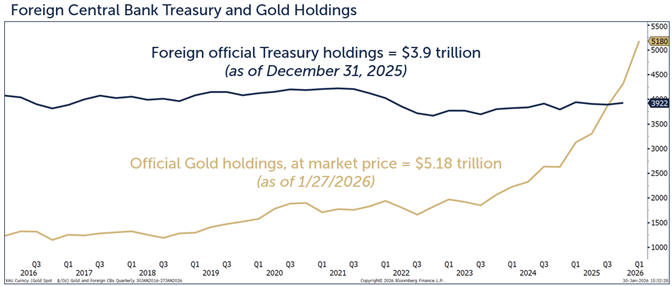
Due to the recent surge in the gold price, gold has now overtaken US Treasuries in central banks’ foreign currency reserves. Before we delve further into the global financial system and the macroeconomic outlook, let’s review how the last month unfolded:
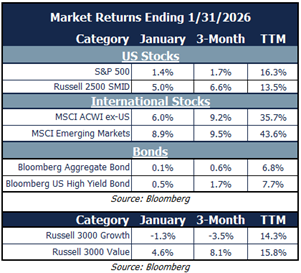
January Market Review
Stock performance broadened beyond large-cap growth to start the year. Solid economic data and strong earnings extended the rally:
- International equities led the march upward with emerging markets surging 8.9% and developed markets following with gains of 6%.
- Small and mid-cap stocks benefited from a very favorable sector and style rotation from growth to value through out the Russell 3000.
- Global stocks have responded positively to improved earnings forecasts across sectors.
- Bonds gained modestly despite slightly higher yields across most of the yield curve.
Classical “January effect” market rotation coupled with geopolitical risk drove January performance:
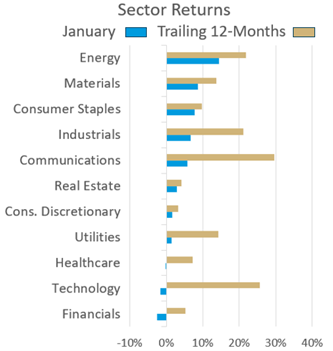
- Energy and materials led the way as the US dollar weakened in the last half of the month.
- Consumer staples performed well on the back of market rotation into dividend strategies.
- Financials, technology and healthcare lagged over the past month. In a classic sign of market rotation accentuated by the “January effect”, momentum and growth were the weakest factor performers following a strong 2025. Leading stocks in these sectors were heavily impacted.
- Dividend strategies and value outperformed growth as the market broadened throughout sectors, capitalization structure and geography.
Our Navigator framework informs our outlook.
February 2026 Navigator Outlook
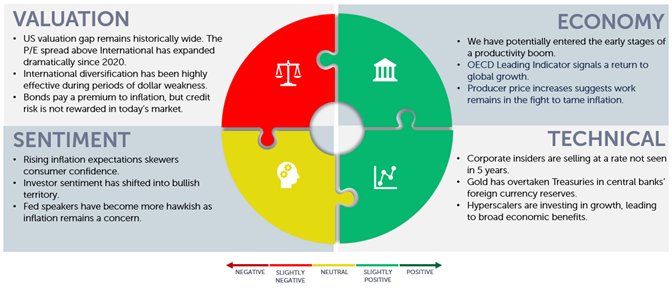
Economy: We have potentially entered the early stages of a productivity boom. OECD Leading Indicator signals a return to global growth. Producer price increases suggests work remains in the fight to tame inflation.
Technicals: Corporate insiders are selling at a rate not seen in 5 years. Gold has overtaken Treasuries in central banks’ foreign currency reserves. Hyper scalers are investing in growth, leading to broad economic benefits.
Sentiment: Rising inflation expectations skewers consumer confidence. Investor sentiment has shifted into bullish territory. Fed speakers have become more hawkish as inflation remains a concern.
Valuation: US valuation gap remains historically wide. The P/E spread above International has expanded dramatically since 2020. International diversification has been highly effective during periods of dollar weakness. Bond spay a premium to inflation, but credit risk is not rewarded in today’s market.
Outlook and Recommendations: New Chair nominated amidst a bullish broadening
As the month came to a close, President Trump announced that Kevin Warsh would be his nominee to serve as the next Chairman of the Federal Reserve after Jerome Powell’s term concludes in May. Following months of consternation, he made a safe and dependable pick to lead the Fed. Warsh is a proven veteran who served as a Fed governor from 2006-2011. While it is presumed that he will lean dovish at the onset, Wall Street sees him as an inflation hawk and believes he understands the significance of central bank independence.
Time will tell if Wall Street has taken the correct view of Warsh. Critics still see him as a “political animal”. Nonetheless, President Trump likes strength and he settled on a persuasive and steadfast candidate even though the nomination presented a dual irony. Central bank independence and the ability to uphold the stable prices half of the Fed’s dual mandate go hand in hand. Those principles were both under threat from recent charges brought by the Justice Department and market fears that the President would pick a pliable candidate. The market reaction can be judged by the sudden reversal in the prices of precious metals and the dollar in the chart below.
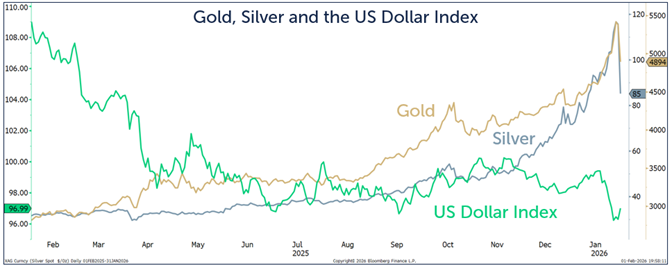
In the record breaking precious metals rally over the last 2months, the silver price nearly doubled and the gold price rose more than 30%. The market reversed course sharply after the nomination announcement, in part due to Warsh’s perceived credibility and in part due to the natural vulnerability of speculative extremes. Given the current debt and deficit issues plaguing many sovereign nations around the world, the rebalancing of central bank balance sheets may continue for some time. However, the recent speculative frenzy may require a period of consolidation.
Amidst the geopolitical tension and central bank concerns that grabbed most of the headlines in January, earnings season started off with a strong positive tone that has supported a strong rotation away from many of last year’s growth and technology leaders into value stocks across the spectrum of market cap and geography.
Nearly half of the S&P 500 has reported fourth quarter earnings thus far. The results have been robust, and revisions suggest that the rate of earnings growth quarters is still accelerating and unlikely to peak until the back half of the year.6 Several mega-cap tech stocks have reported solid results and raised their expectations for AI capex. There have been varied stock price reactions indicating that the market is becoming more discerning regarding spending intentions and free cash flow projections.
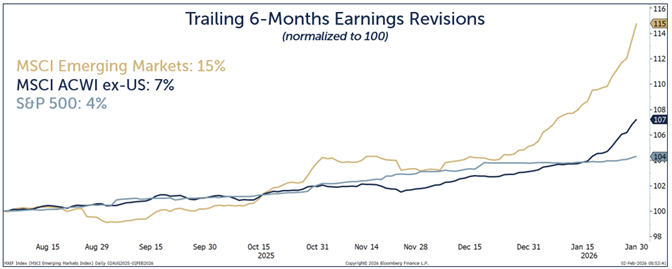
The good news is that fundamental support for has broadened to other areas of the market. Earnings revisions for emerging markets and developed markets have accelerated over the last few months and are running well above the S&P 500 on a trailing 6-months basis as depicted in the chart below.
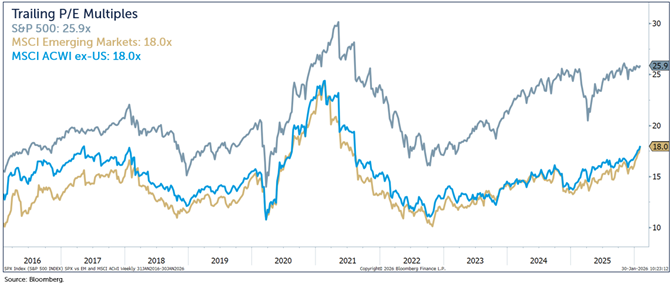
In addition, the valuation gap between US equities and the rest of the world has widened significantly since 2020. The P/E spread between the US and developed and emerging economies used to range between 3-5 multiple points prior to the pandemic, but since the pandemic and the monetary and fiscal expansion supporting the AI build-out, the spread has increased to a range of 6-10 points. Improving company fundamentals for international equities and concerns regarding narrow performance and high valuations of US mega-cap growth stocks should provide support for a narrowing of this spread.
Adding the previously discussed geopolitical and macroeconomic factors to the mix only enhances the case for international diversification. The following chart from JP Morgan7 illustrates that developed markets outperformance versus the US has historically coincided with periods of US Dollar weakness. This chart measures total return on a rolling 3-year basis and it has been over a decade since international markets showed a sustainable advantage.
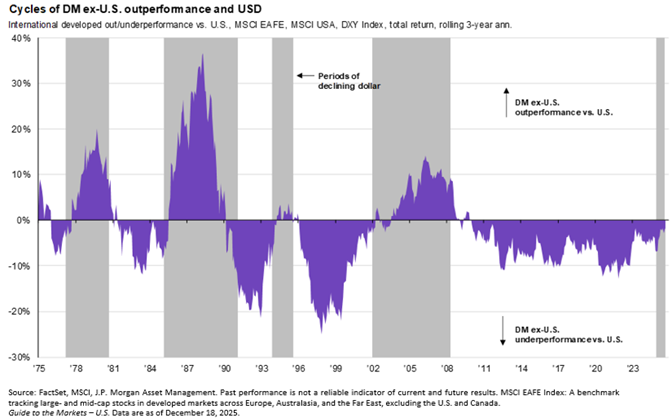
The historical record indicates that international markets sustained performance advantages versus the US over extended timeframes with much higher frequency prior to the Great Financial Crisis. Even though 2025 was a strong year for international diversification, the case continues to be strong with recent fundamentals accelerating, a sizeable valuation gap and a change ahead at the helm of the Federal Reserve.
Portfolio Construction and Positioning
The combination of strong earnings, supportive fiscal policy and recent rate cuts have continued to drive the S&P 500 to new all-time highs, and financial markets have broadened across sectors, style and geography.
Geopolitical tensions have heightened and changes ahead in the leadership of the US central bank present risks to current fundamentals. We continue to believe investors are over looking the risks of concentrated leadership among U.S. Mega cap technology stocks. Valuations in other areas of the market remain compelling, and diversification benefits have historically proven to be beneficial following periods of high concentration. Our portfolios remain well diversified by geography, style and market cap.
Our Navigator process helps guides both short-and medium-term tactical adjustments:
- Mid-caps, value, dividend stocks and international equities:
- These segments offer attractive valuations relative to U.S. large caps and provide long-term diversification benefits.
- Balanced exposure across styles: We maintain a mix of growth stocks poised to benefit from technological innovation and value stocks offering upside potential with an emphasis on cash flow and dividends.
- Fixed income remains compelling: Bond yields exceed the earnings yield of large-cap equities, and real (inflation-adjusted) yields are positive—supporting the case for continued fixed income exposure.
- Mortgage-backed securities: We see favorable risk-reward dynamics here, though tight corporate credit spreads warrant caution.
- Alternative investments: We continue to find meaningful opportunities in both non-correlated strategies and private market investments.
Constructing portfolios that are resilient and capable of compounding effectively over time is our primary goal. We are mindful of risks to the outlook remain focused on the value of discipline and diversification.
This material is intended to be educational in nature, and not as a recommendation of any particular strategy, approach, product or concept for any particular advisor or client. These materials are not intended as any form of substitute for individualized investment advice. The discussion is general in nature, and therefore not intended to recommend or endorse any asset class, security, or technical aspect of any security for the purpose of allowing a reader to use the approach on their own. Before participating in any investment program or making any investment, clients as well as all other readers are encouraged to consult with their own professional advisers, including investment advisers and tax advisors. OneAscent can assist in determining a suitable investment approach for a given individual, which may or may not closely resemble the strategies outlined herein.
Source: Wikipedia – “2026 United States intervention in Venezuela.”
Source: Wikipedia – “2026United States intervention in Venezuela”. Source articles from the Associated Press and Reuters.
Source: Bloomberg story, “Trump Rules Out Force to Take Greenland, Burt Says He’ll Remember”, dated January 21, 2026, written by Hadriana Lowenkron.
Source: Bloomberg story, “Trump Finds Greenland Off-Ramp, EU Dodges Levy”, dated January 21, 2026,written by Jennifer Welch and Antonio Barroso.
Source: ABC News story, “Trump says ‘massive Armada’ heading to Iran, warns time running out for a nuclear deal”, dated January 28, 2026, written by Alexandra Hutzler, Chris Boccia, Luis Martinez and Steven Beynon.
Source: Goldman Sachs “Weekly Kickstart: Mid-season S&P 500 earnings update”, dated January 30, 2026.
Source: JP Morgan Asset Management – chart from Guideto the Markets.
Source: Market Returns reference the following indices: Large Cap – S&P 500, Mid Cap Growth – Russell Midcap growth, Mid Cap Value – Russell Midcap Value, Small Cap – Russell 2000, Developed – MSCI EAFE, Emerging – MSCI Emerging Markets, Aggregate – Bloomberg US Aggregate, High Yield – Bloomberg High Yield
OAI01444