

Key Events: Oil price spikes as Mideast War intensifies
War in Iran sent shockwaves across global markets last week. Volatility, as measured by the VIX Index, nearly reached 30 for the first time since last April and the West Texas Intermediate (WTI) crude oil price surged past $90 for the first time since 2023.1
As the war enters week two, key questions regarding the magnitude of disruptions and the length of Mideast conflict are set to determine the market’s risk threshold.
Market Review: Sharp reversal of recent trends
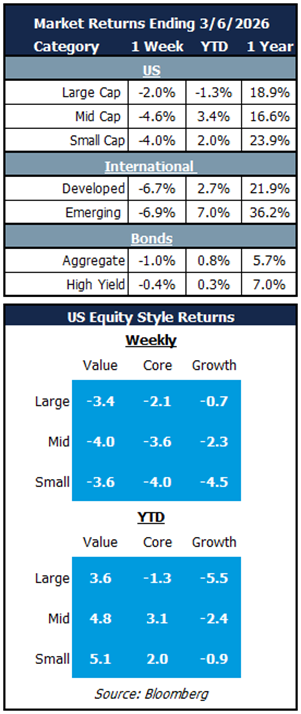
Through the first two months of 2026, the broadening of performance across asset classes was pronounced. The onset of war in Iran marked a sharp reversal. International equities suffered the most, dropping nearly 7%, and large cap US equites suffered least, with a decline of 2%.
Bonds also backtracked on heightened inflation concerns from sharply rising commodity prices.
Outlook: Geopolitical shocks create opportunity
The historical record clearly suggests that geopolitical events create buying opportunities. As John Authers states in his article titled, “Commit What You Know of Iran to the Flames”, geopolitical shocks “do so because they create the risk of a bad outcome” .2 The market generally responds to heightened risk by inducing a sell-off. Once the shock is resolved, investors are often presented with a slew of underpriced risk assets.
This process has generously rewarded those who take risk in uncertain moments, but it has also rewarded those who simply stick to a long-term plan and maintain steady resolve throughout periods of volatility. The most recent example was last year’s market response to tariffs and trade wars.
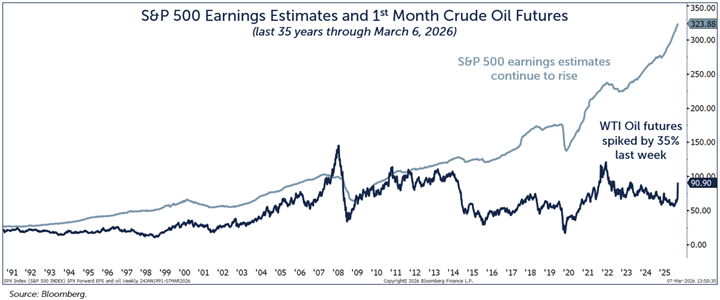
Over the past 35 years, S&P 500 earnings have progressed in the face of periodic bouts of oil price volatility with only a few setbacks. This is clearly illustrated by the chart below showing the progression of earnings estimates against the WTI crude oil 1st month futures.3
Ironically, earnings setbacks appear more likely during weak oil price environments that are induced from weakening economic conditions rather than from oil price spikes. However, an extremely extended and sustained spike can lead to dire economic consequences. With the effective closure of the Strait of Hormuz forcing several Mideast countries to halt oil production, the risk of stagflation has risen, and the magnitude and length of the conflict remains unknown.
Long-term success from equity market investing has been highly correlated to the rate of earnings growth over time, not geopolitical risk events and commodity price spikes. Global markets are likely to experience more exaggerated volatility, and the theme of broadening may take a breather while fear from current oil market chaos grabs the headlines. Adherence to foundational portfolio principles of diversification, discipline and long-term focus remain the most effective approach to navigate today’s uncertain environment.
Earnings Compound Resiliently Through Oil Price Volatility
OneAscent Navigator Outlook: March 2026
This material is intended to be educational in nature , and not as a recommendation of any particular strategy, approach, product or concept for any particular advisor or client. These materials are not intended as any form of substitute for individualized investment advice. The discussion is general in nature, and therefore not intended to recommend or endorse any asset class, security, or technical aspect of any security for the purpose of allowing a reader to use the approach on their own. Before participating in any investment program or making any investment, clients as well as all other readers are encouraged to consult with their own professional advisers, including investment advisers and tax advisors. OneAscent can assist in determining a suitable investment approach for a given individual, which may or may not closely resemble the strategies outlined herein.4
1) Source: Bloomberg data.
2) Source: Bloomberg story from John Authers, “Commit What You Know of Iran to the Flames”, dated March 6, 2026.
3) Source: Bloomberg data.
4) Market Returns reference the following indices: Large Cap – S&P 500, Mid Cap Growth – Russell Midcap growth, Mid Cap Value – Russell Midcap Value, Small Cap – Russell 2000, Developed – MSCI EAFE, Emerging – MSCI Emerging Markets, Aggregate – Bloomberg US Aggregate, High Yield – Bloomberg High Yield
OAI01478