

Fragility under the surface
February’s market performance exposed some cracks in the markets.
Markets projected confidence, yet the underlying tone was anything but stable. Growth indicators improved but policymakers emphasized how uneven the momentum truly was. The San Francisco Fed warned that despite robust forward‑looking output expectations, the labor market had cooled more than headline January payrolls suggested, and inflation progress had stalled with core PCE stuck around 3%. At the same time, S&P Global’s PMI data pointed to a pickup in manufacturing, yet survey respondents continued to flag geopolitical and trade uncertainty as a central drag on confidence. Together, these signals painted a picture of an economy moving forward—but on a footing far less solid than the top‑line numbers implied.
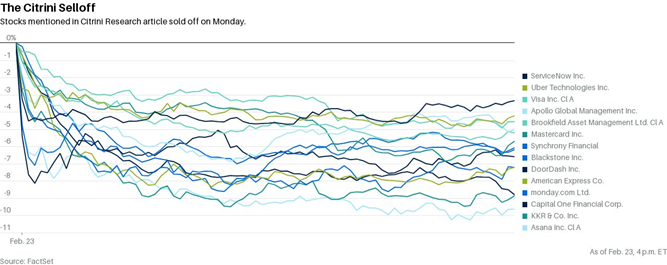
That fragility grew increasingly visible as geopolitical and market pressures rattled markets. The U.S. administration’s sweeping 10% import‑tariff announcement reignited global trade tensions, and a research article that suggested a “human intelligence displacement spiral” would lead to a significant economic downturn drove AI related stocks down1. The fact that an unknown firm’s research would lead to such a selloff – a ‘mini-deepseek moment’what is the short cut2 – illustrates the frailty of today’s markets.
Treasury yields slid as cooling inflation data combined with risk‑off sentiment, highlighting how quickly growth optimism could reverse when uncertainty rose. Meanwhile, the Fed’s “hawkish delay”—signaling rates may stay restrictive until late 2026—kept markets guessing about the path ahead, reflecting policymakers’ own unease about sticky inflation and uneven demand. In all, February reminded investors that beneath the veneer of resilience, the market remained highly sensitive to shocks—an environment where fragility, not stability, was the dominant theme. After markets closed the last day of February, we were given another shock to the system as US And Israeli forced attacked Iran.
February Market Review
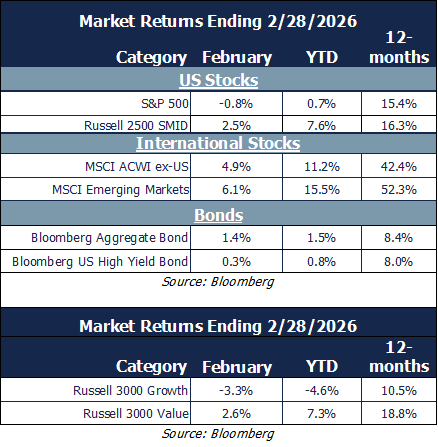
Markets broadened further in February:
- International equities continued to outperform, with emerging markets and Asia‑Pacific leading global returns on the back of strong earnings and improving business activity abroad.
- U.S. small and mid‑cap stocks again outpaced mega‑ caps in a continued leadership rotation toward cyclicals and value‑oriented.
- Bonds gained as yields dropped due to a combination of reduced inflation fears and increased worry over AI fears which drove a rotation to bonds.
Broadening market leadership also shaped February sector performance:
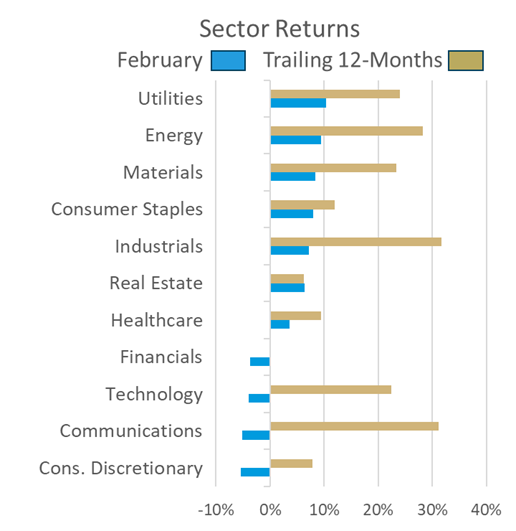
- Financials sold off as potential AI disruption presented heightened risks to the sector.
- Technology stocks also sold off on AI fears; newly released AI tools raised concerns over the outlook for the software business.
- Energy, materials and consumer staples gained as the market rotated away from high-flying sectors; energy also benefitted from expectations of increased energy consumption.
Our Navigator framework informs our outlook.
March 2026 Navigator Outlook
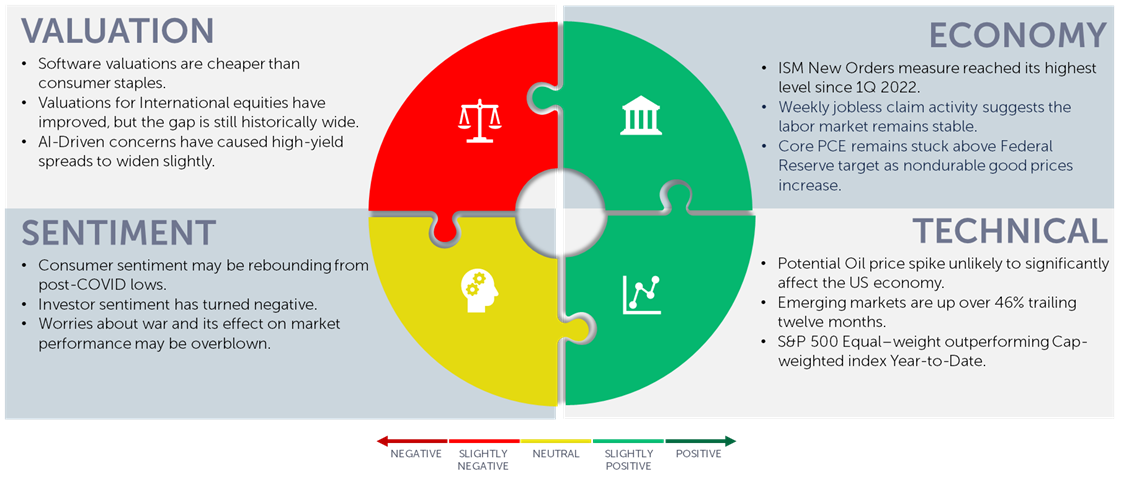
Economy: Signs of optimism include the ISM New Orders measure, which reached its highest level since 1Q 2022, and weekly jobless claim activity suggests the labor market remains stable. Core PCE remains stuck above Federal Reserve target, however, as nondurable goods prices increased – energy is part of the non-durable goods category.
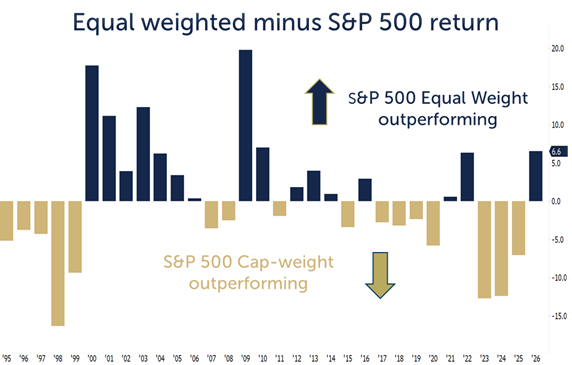
Technicals: A potential Oil price spike is unlikely to significantly affect the US economy. Emerging markets are up over 46% trailing twelve months, but signs of broadening bode well, such as the S&P 500 Equal–weight outperforming Cap-weighted index Year-to-Date.
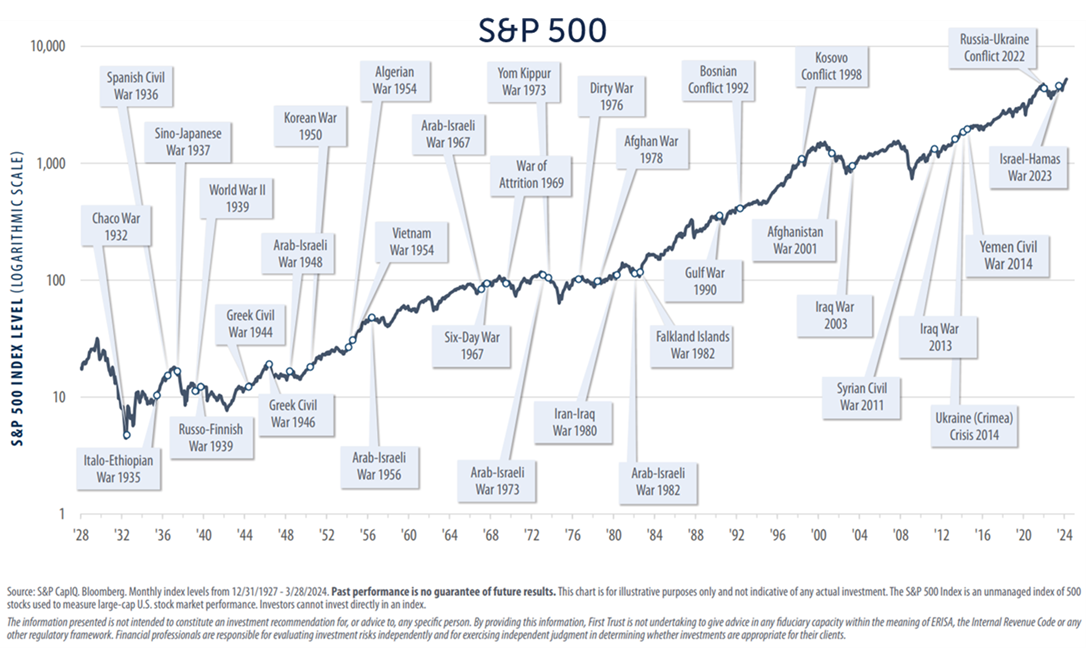
Sentiment: Consumer sentiment may be rebounding from post-COVID lows, while investor sentiment has turned negative again. Worries about war and its effect on market performance may be overblown, as war rarely has had a significant long-term effect.
Valuation: Software valuations are cheaper than consumer staples after a technology selloff. Valuations for International equities have improved, but the gap is still historically wide. Meanwhile, AI-Driven capex spending concerns caused high-yield spreads to widen slightly.
Outlook and Recommendations: Managing through war and market volatility
Markets enter March with a mix of renewed optimism and understandable short‑term anxiety. Ongoing geopolitical tensions and fluctuations in oil prices have increased volatility and raised near‑term concerns for many investors. These risks are real, and they can influence sentiment in the short run. But historically, even meaningful external shocks—from conflicts to commodity spikes—have tended to leave only temporary marks on long‑term portfolio outcomes. Our message to investors remains clear: acknowledge these risks, but don’t let them dictate your long‑term strategy.
The U.S. economy remains supported by resilient consumer spending, steady job growth, and ongoing investment in productivity‑enhancing technologies. These are important tailwinds for long‑term investors. At the same time, risks remain: certain pockets of the U.S. market are still priced for perfection, and elevated interest rates continue to pressure rate‑sensitive sectors. Internationally, fundamentals are healing, but growth remains uneven across regions.
Beneath these headlines, the market continues to show encouraging signs of broadening leadership. After several years dominated mega cap technology names, we’re now seeing more participation from small- and mid‑cap companies, as well as international markets where earnings trends and valuations have been improving. This shift is healthy—it reflects a market driven less by a handful of giants and more by a wider base of fundamental strength.
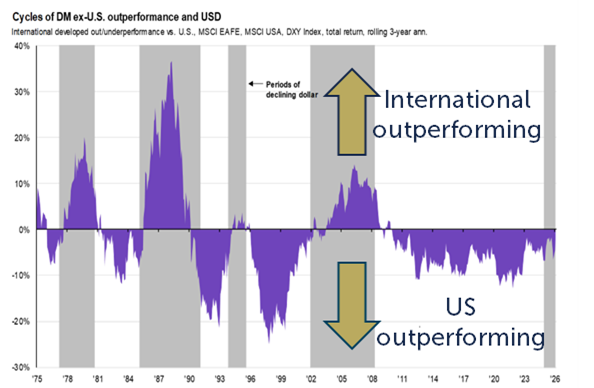
The charts below show equal weight vs market weight US performance3 and the rolling three year measure of US vs international performance4. These charts suggest a “Brobdingnadian” – significant and sustainable – shift away from the mega caps towards small and midcaps, international and emerging market stocks is under way that may be measured in years, not months.
While short‑term noise can feel overwhelming, the broader market backdrop continues to improve. Widening participation across market caps and geographies, combined with resilient underlying economic conditions, provides a constructive foundation for long‑term investors. Staying disciplined, diversified, and focused on fundamentals remains the best response to an environment that is both more volatile—and more opportunity‑rich—than it may appear in the headlines.
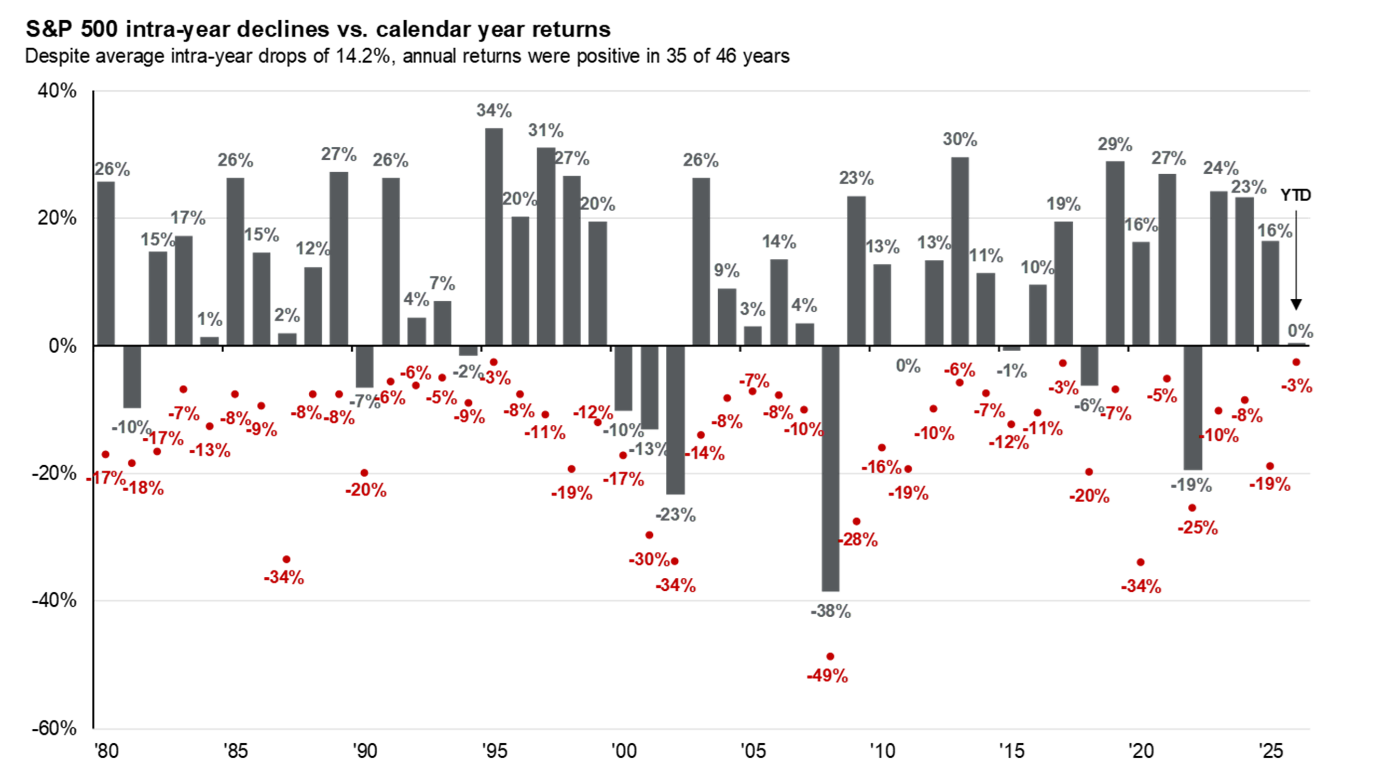
Two risks to the outlook bear mentioning: there is some volatility under the surface of the markets. While the chart above illustrates that the S&P 500 has only had a 3% loss so far this year5, 115 names in the index are down 5% or more6, and the average loss for that group in the first two months of the year is 15%. This significant variance in performance suggests that, while there is broad participation, there are also potholes to avoid; our portfolio construction is designed to guide portfolios over these rough roads.
Another risk – one where we would caution against overreaction – is the war in the middle east. The chart to the right illustrates a very modest affect7 on US inflation (+.75%) and economic GDP growth (-.2%) from a significant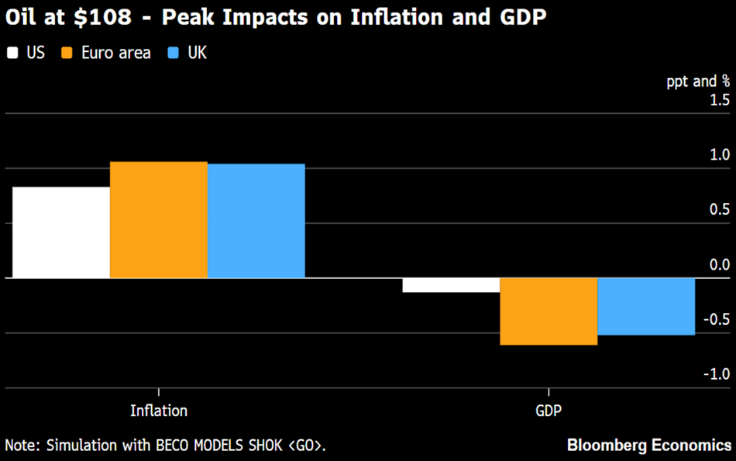 increase in the price of oil, as the US has become a net exporter of oil. The Chart below shows that, while war tends to increase volatility in the short-term, there is generally low to moderate long-term effects.8
Portfolio Construction and Positioning
Our Navigator process helps guide our portfolio construction:
- Mid-cap and international equities: These segments offer attractive valuations relative to U.S. large caps and provide long-term diversification benefits.
- Balanced exposure across styles: We maintain a mix of growth stocks poised to benefit from technological innovation, despite their recent selloff, and value stocks offering upside potential with an emphasis on cash flow and dividends.
- Fixed income remains compelling: Bond yields exceed the earnings yield of large-cap equities, and real (inflation-adjusted) yields are positive—supporting the case for continued fixed income exposure. Credit spreads have widened slightly as the market has questioned AI-driven capex funded with debt. This has made the overall market for corporate credit slightly more attractive.
- Mortgage-backed securities: We see favorable risk-reward dynamics here, though tight corporate credit spreads warrant caution.
- Alternative investments: We continue to find meaningful opportunities in both non-correlated strategies and private market investments.
Constructing portfolios that are resilient and capable of compounding effectively over time is our primary goal. We are mindful of risks to the outlook remain focused on the value of discipline and diversification.
Constructing portfolios that are resilient and capable of compounding effectively over time is our primary goal. We are mindful of risks to the outlook remain focused on the value of discipline and diversification.
This material is intended to be educational in nature, and not as a recommendation of any particular strategy, approach, product or concept for any particular advisor or client. These materials are not intended as any form of substitute for individualized investment advice. The discussion is general in nature, and therefore not intended to recommend or endorse any asset class, security, or technical aspect of any security for the purpose of allowing a reader to use the approach on their own. Before participating in any investment program or making any investment, clients as well as all other readers are encouraged to consult with their own professional advisers, including investment advisers and tax advisors. OneAscent can assist in determining a suitable investment approach for a given individual, which may or may not closely resemble the strategies outlined herein.
1 Source: Citrini Research, X THE 2028 GLOBAL INTELLIGENCE CRISIS , Josh Schafer on X:
2 Source: IFRI A “DeepSeek Moment”?
3 Source: Bloomberg
4 Source: JP Morgan https://cdn.jpmorganfunds.com/content/dam/jpm-am-aem/americas/us/en/insights/market-insights/gtm/monthly/widescreen-slides/Slide43.PNG?v=1772634395259

5 Source: JP Morgan
6 Source: Bloomberg
7 Source: Bloomberg
8 Source: First Trust Portfolios
9 Source: Market Returns reference the following indices: Large Cap – S&P 500, Mid Cap Growth – Russell Midcap growth, Mid Cap Value – Russell Midcap Value, Small Cap – Russell 2000, Developed – MSCI EAFE, Emerging – MSCI Emerging Markets, Aggregate – Bloomberg US Aggregate, High Yield – Bloomberg High Yield
OAI01477