

AI and spending milestones make their mark in a volatile November
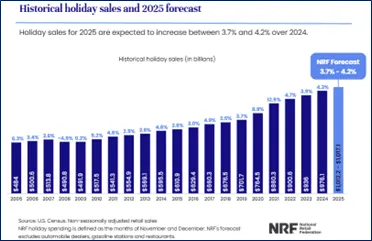
November was a month of milestones – two stand out: Black Friday sales surged to a record yet again, showcasing the strength of the US consumer – at least the high-end consumer that can afford to splurge during the holidays and has not been affected by the US Government shutdown. Capital One estimates that the average consumer spends $650 over the black Friday – Cyber Monday weekend.
In addition, the National Retail Federation is forecasting a 3.7%-4.2% increase over last year’s holiday season with sales exceeding $1 trillion for the first time this holiday season.¹
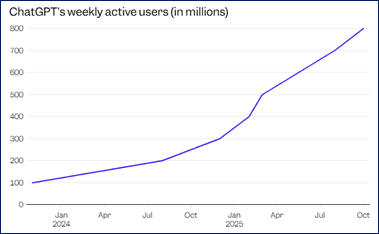
November 30 also marked three years since the release of ChatGPT. Since that time, ChatGPT’s user base has grown by 700% as depicted in this chart from Axios and Reuters². During this meteoric rise, weekly active users have expanded to 800 million and growing. According to a recent story from Business Insider, Sam Altman said “Language interfaces are going to be a big deal” in November of 2022³. That would be considered more than just a modest understatement today. With the emphatic
support of Microsoft in early 2023, ChatGPT’s widespread adoption has helped OpenAI become a leader in the AI race, with stiff competition coming from Meta, Google (Gemini), xAI (Grok) and Anthropic (Claude).
Recent developments may be throwing the leadership position into question as Google‘s release of Gemini 3 has leapfrogged all other AI tools and established Google as the current performance leader with “state-of-the-art scores across reasoning, math and multimodal benchmarks”⁴. The race to develop the most robust AI models entails significant implications for the economy, financial markets and geopolitics. Before we assess the ramifications affecting our outlook and positioning, let’s review how November unfolded.
November Market Review
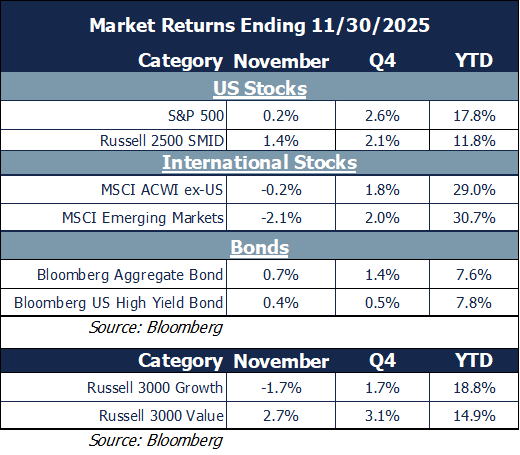
Markets diverged in November:
- Emerging markets led the retreat, but YTD gains still lead at over 30%.
- International and US large cap stocks finished essentially flat, as technology drove losses.
- US mid and small caps rose, along with value stocks, in a broadening that went counter to recent technology-driven return patterns.
- Bonds gained as a moderating job market increased rate cut expectations.
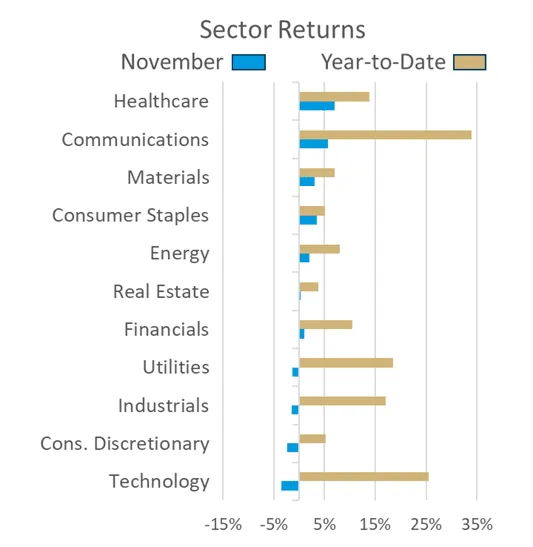
Sector performance showed some notable shifts:
- Healthcare led for the month as the market rotated in favor of value over growth.
- Previous leaders, technology and consumer discretionary pulled back in November.
- Communications was the sole growth sector to show a positive on the back of standout performance from Google.
- Materials, consumer staples, energy, real estate, and financials benefited from the rotation away from highly valued growth stocks into value oriented sectors.
- The long awaited broadening of markets finally started to take shape as the small and mid-cap indices outperformed large caps along with the rotation to value.
Our Navigator framework informs our outlook.
December 2025 Navigator Outlook
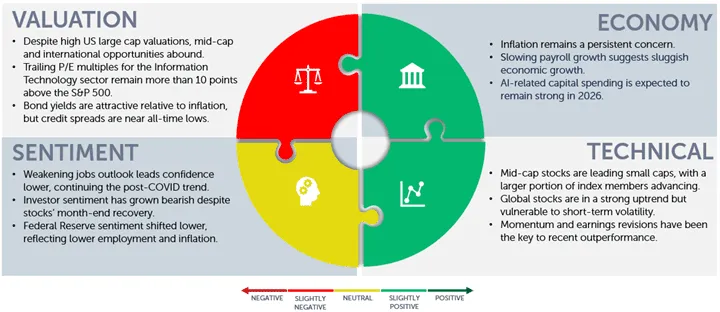
Economy: Inflation remains a persistent concern, while slowing payroll growth suggests sluggish economic growth. AI-related capital spending is expected to remain strong in 2026, supporting economic growth.
Technicals: Mid-cap stocks are leading small caps, with a larger portion of index members advancing. Global stocks are in a strong uptrend but vulnerable to short-term volatility. Momentum and earnings revisions have been the key to recent outperformance.
Sentiment: A weakening jobs outlook is leading consumer confidence lower, continuing the post-COVID trend. Investor sentiment has grown bearish despite stocks’ month-end recovery. Federal Reserve sentiment shifted lower, reflecting lower employment and inflation which may provide cover for rate cuts.
Valuation: Despite high US large cap valuations, mid-cap and international opportunities abound. Trailing P/E multiples for the Information Technology sector remain more than 10 points above the S&P 500. Bond yields are attractive relative to inflation and risky assets, but credit spreads are near all-time lows.
Outlook and Recommendations: The AI boom continues but the story is shifting
The significance of the AI investment cycle seems rather difficult to overstate at the current moment in the business cycle. It is underpinning GDP growth and providing construction jobs at a time when talk of a “K-shaped” economy in inescapable. Spending for the high-end consumer continues apace, while the bottom half of the income distribution is showing signs of credit stress in credit card and delinquency data. Consumer sentiment remains very low and the unemployment rate is running at its highest level in over 3 years at 4.3%.⁵
The weakness in overall employment may give the Federal Reserve flexibility to cut rates further and help bridge the gap to a more accomodative environment in 2026. This would enable a modest economic reacceleration. A continuation of the impressive AI spending cycle would almost certainly be a prerequisite for this potential outcome.
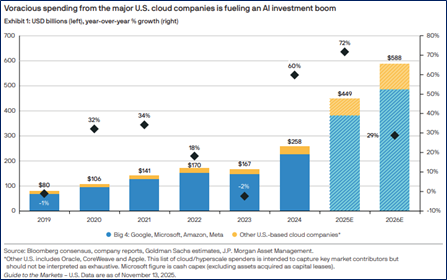
The spending appetite since the 2023 cycle lows for the major hyperscalers has been nothing short of spectacular as shown by the chart to the right from JP Morgan’s 2026 Investment Outlook.⁶ After 60% growth in 2024, the Big 4 AI spenders (Google, Microsoft, Amazon and Meta) along with other US based cloud companies accelerated their investment boom to an estimated 72%. While that torrid rate of growth is unlikely to be sustained, the level of spending is expected to grow by nearly $140 billion in 2026 even though growth likely decelerates to 29% according to the data provided.
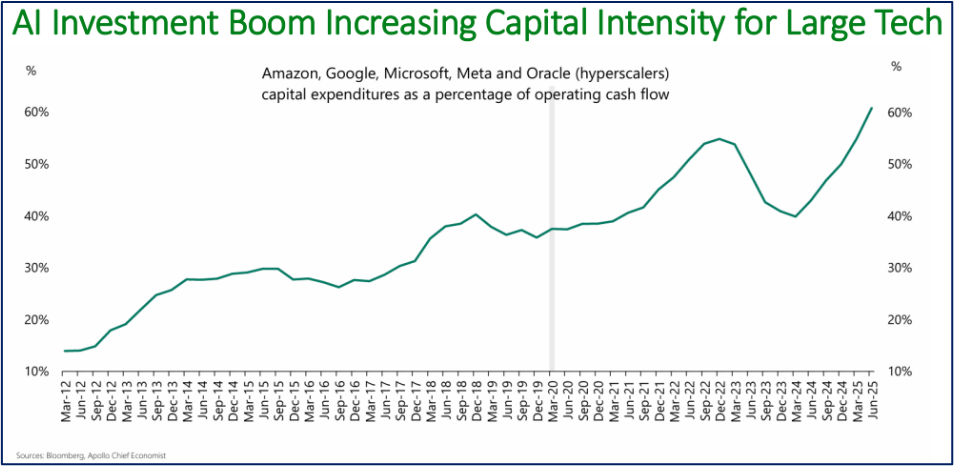
The forecast is not without risk. The large cap hyperscalers (with Oracle added to the list in this chart from Apollo⁷) have all seen their capital intensity surge higher over the last 18 months and they now have much less free cash flow available for buybacks and dividends. If shareholder returns disappoint over the intermediate term, pressure to reduce capex may begin to mount and corporate belt-tightening could ensue.
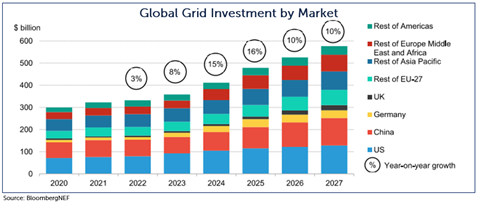
In addition to the capital intensity developments facing the hyperscalers, the global economy is up against a significant energy bottleneck. Data‑center power demand is rising much faster than transmission can be built. BloombergNEF now sees U.S. data centers drawing 106 GW by 2035 (roughly triple today’s load), with PJM and ERCOT flagged as near‑term stress points.⁸ Grid capex is climbing, yet interconnection and equipment lead times remain binding constraints. The forecast for global grid investment to grow by 10% per annum over the next 2 years may not provide ample supply for the projected data center requirements and the cost increases that are already being imposed on consumers in several regions are simply adding to the “K-shaped” concerns facing policymakers and energy commission regulators.
In summary, the investment in the grid to support the AI buildout remains supportive of near‑term growth but comes with investment boom cycle realities: free cash flow can compress and resources can become scarce driving costs beyond acceptable levels. Efficiency becomes paramount in such a scenario and the market may already be adjusting its focus to lower cost AI solutions.
The market diverged from recent trends in November and it suffered a fairly significant setback through the first three weeks with the S&P 500 down as much as 5.1% from recent highs before recovering in the last 2 weeks of the month. Dividend Aristocrats, Value stocks and Mid-caps all performed well throughout the month while Growth stocks were dragged down by the noteworthy underperformance of Information Technology as depicted in the November Performance chart.
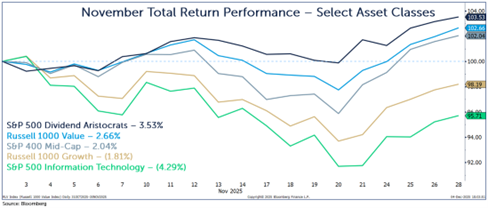
The AI investment boom is certain to provide transformational benefits to the economy, but the trajectory could dramatically slow if the growth rate and/or the level of profitability are impacted. The risks to both are becoming apparent and the Google release of Gemini 3 suggests that some of the risk is coming from within the increasingly competitive hyperscaler circle.
Moreover, Google’s Tensor Processing Units (TPUs) may be able to deliver similar performance for certain AI applications to Nvidia’s Graphics Processing Units (GPUs) at lower cost. These developments could certainly affect the trajectory of the AI boom and could materially lower the expectations for future profits to the leading AI enterprises. With market concentration at historic levels, the implications for markets would undoubtedly favor a diversified approach to portfolio management.
Portfolio Construction and Positioning
Strong earnings, supportive fiscal policy and recent rate cuts have continued to both support the economy and stock market valuations.
While valuations for many growth stocks appear to be quite lofty, other areas of the market remain compelling, and diversification benefits have historically proven to be most beneficial following periods of high concentration. Our portfolios remain well diversified.
Our Navigator process helps guides both short- and medium-term tactical adjustments:
- Mid-caps, value, dividend stocks and international equities: These segments continue to offer attractive valuations relative to U.S. large cap growth and the market may finally be waking up to the discrepancy on the back of November’s performance for mid-caps, value and dividend stocks in the domestic market.
- Balanced exposure across styles: We maintain a mix of growth stocks poised to benefit from technological innovation and value stocks offering upside potential and, in many cases, strong dividend profiles.
- Fixed income remains compelling: Bond yields exceed the earnings yield of large-cap equities, and real (inflation-adjusted) yields are positive—supporting the case for continued fixed income exposure.
- Mortgage-backed securities: We see favorable risk-reward dynamics here, though tight corporate credit spreads warrant caution.
- Alternative investments: We continue to find meaningful opportunities in both non-correlated strategies and private market investments.
Our goal is to build portfolios that are resilient and capable of compounding effectively over time. We are mindful of risks to the outlook remain focused on the value of discipline and diversification.
This material is intended to be educational in nature, and not as a recommendation of any particular strategy, approach, product or concept for any particular advisor or client. These materials are not intended as any form of substitute for individualized investment advice. The discussion is general in nature, and therefore not intended to recommend or endorse any asset class, security, or technical aspect of any security for the purpose of allowing a reader to use the approach on their own. Before participating in any investment program or making any investment, clients as well as all other readers are encouraged to consult with their own professional advisers, including investment advisers and tax advisors. OneAscent can assist in determining a suitable investment approach for a given individual, which may or may not closely resemble the strategies outlined herein.
¹ Source: National Retail Federation article, “NRF expects robust spending during the holiday season” by Mark Mathews, dated 11/13/2025.
2 Source: Chart sourced from Axios and Reuters as shared in a Business Insider article: “ChatGPT is now being used by 10% of the world’s adult population”, by Jennifer Sor, dated 10/9/2025.
3 Source: Business Insider article: “3 years old, 800 million users, 29,000 prompts a second: Chat GPT’s meteoric rise, by the numbers”, by Lauren Edmonds, dated 12/1/2025.
4 Source: Business Insider article: “3 years old, 800 million users, 29,000 prompts a second: Chat GPT’s meteoric rise, by the numbers”, by Lauren Edmonds, dated 12/1/2025.
5 Source: Bloomberg data.
6 Source: JP Morgan 2026 Year-Ahead Investment Outlook.
7 Source: JP Morgan 2026 Year-Ahead Investment Outlook.
8 Source: BloombergNEF – US Data Center Outlook 2H 2025: The boom gets bigger, dated December 1, 2025.
⁹ Source: Market Returns reference the following indices: Large Cap – S&P 500, Mid Cap Growth – Russell Midcap growth, Mid Cap Value – Russell Midcap Value, Small Cap – Russell 2000, Developed – MSCI EAFE, Emerging – MSCI Emerging Markets, Aggregate – Bloomberg US Aggregate, High Yield – Bloomberg High Yield
OAI01411